


Use onomeo in Crush
Crush is a coding agent that works in the terminal and reads its settings from a file named crushrc. Follow the four steps below to write this site into that file and use its models.
A coding agent for the terminal, from Charm.
The three values it asks for
OpenAI-compatible
Use these details in any OpenAI-compatible tool.
No key yet? Create one on the My account page, then come back — the fields below fill in by themselves. Go to My account
Step by step
Install Crush
On Windows, press the Windows key, type PowerShell and press Enter. On macOS, open Terminal. Paste the line below and press Enter.
npm install -g @charmland/crush
If npm is not found, install Node.js (the LTS version) from nodejs.org first, then close PowerShell and open it again. On Windows, winget install charmbracelet.crush installs it as well.
Save the configuration
Press Copy, paste the command into the same window and press Enter. It writes this site's address, your key and the model auto into Crush's crushrc file.
$f = "$HOME\.config\crush\crushrc"
if (-not (Test-Path $f)) {
New-Item -ItemType Directory -Force -Path (Split-Path $f) | Out-Null
[IO.File]::WriteAllText($f, @'
provider add onomeo --type openai-compat --base-url "https://onomeo.com/v1" --api-key "YOUR_API_KEY"
model add onomeo/auto --name "onomeo auto" --context-window 128000 --default-max-tokens 16000
'@)
Write-Host "Saved: $f" -ForegroundColor Green
} else { Write-Host "Config file already exists, left unchanged: $f" -ForegroundColor Yellow }
Replace YOUR_API_KEY in the command with your key. Once you create a key in this browser, it is filled in here.
The last line reads Saved in green when the file is written. If the yellow line "Config file already exists, left unchanged" appears instead, Crush is already set up on this computer: open the file it names and add the two lines starting with provider add and model add by hand.
Start Crush
Go to your project folder first (for example, type cd D:\my-project and press Enter), then run the line below. Under the folder name, Crush shows the model it will use: onomeo auto via onomeo.
crush
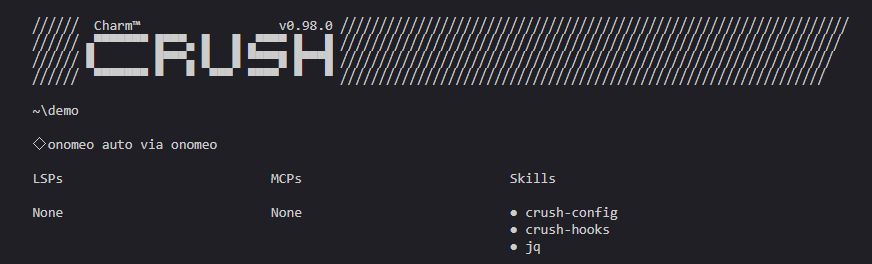
onomeo auto via onomeo means requests go to this site. Give it a task
Type what you want done and press Enter. Before it writes a file or runs a command, Crush asks for permission: press Enter on Allow.
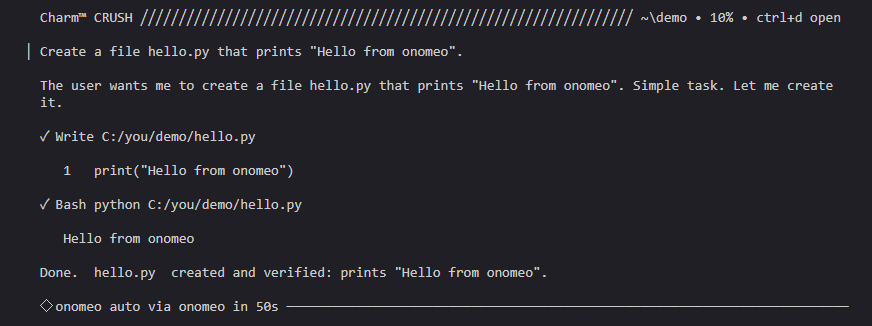
Here it was asked to create hello.py: once allowed, it wrote the file, ran it to check, and reported the output. Each step counts as 1 call, and a long step counts as several by its length. Measured on 9 October 2026 with Crush 0.98.0: the task above took 4 calls on auto and was not charged.
If it will not connect
- Keep /v1 on the end of the base URL and add nothing after it; Crush adds /chat/completions itself.
- To add another model from the Models page, add another model add onomeo/<name> line to the crushrc file. In Crush, Ctrl+M switches between models.
- Coding sends whole files along with each request. On free models that is not charged, but a long request counts as several calls; Claude, GPT and other big models are charged by usage, and the balance goes quickly.
- 401: the key is wrong; correct it after --api-key in the crushrc file. 402: insufficient balance. Claude, GPT and other big models are charged by usage; top up on the Pricing page or switch to a free model.
- Once your own provider keys are connected on the My providers page, add a line model add onomeo/my/<provider>/<model> to answer on your own allowance instead. Nothing else changes, and this site does not charge for these calls.